What: Gold Dome Press Conference

NEW REPORT: Georgia’s 2024 Voting System Analyzed Across 7 Counties
When: 1/20/26, 2:00PM

Where: State Capitol South Wing Steps

About the Report: The Seven-County Investigation is a data-driven review of official tabulator logs obtained via Open Records Requests, comparing observed performance against EAC and Georgia constitutional mandates. The full report will be published here on Georgians For Truth on January 20th. We will attempt to live stream the press conference. More details to come.

Why Independent Oversight Matters Now More Than Ever

By Field Searcy
January 4, 2026

A coordinated narrative is taking shape in Georgia politics: the State Election Board is “ineffective,” “dysfunctional,” and “unable to process cases.” That storyline, pushed by political allies of Governor Brian Kemp and Secretary of State hopefuls, conveniently points to one solution—restructure or abolish the SEB, or fold it fully back under the control of the Secretary of State’s office. That would be a profound mistake for election integrity and public trust.

Who Really Controlled Cases Until Now

For years, the Secretary of State’s office effectively controlled the investigative pipeline. It decided which complaints to investigate, which to slow‑walk, and which—if ever—to send to the SEB. Most of what did reach the Board were low‑impact, technical violations: paperwork errors, minor procedural missteps, issues that rarely touched enough votes to alter an outcome. Meanwhile, serious 2020‑election cases with potential impact in the tens or hundreds of thousands of votes languished in limbo or were never meaningfully advanced.

The situation reached a new low when the Secretary of State’s office stopped sending investigators to SEB meetings to present and explain cases, cutting off members from the very staff who had handled the investigations. That is not the behavior of an office eager for accountability; it is the behavior of an office determined to control the narrative and limit scrutiny.

Against that backdrop, the recent push in some media outlets to brand the SEB “ineffective” looks less like neutral analysis and more like a political strategy: discredit the one body that has begun to ask hard questions, and then argue that only by neutering or abolishing it can Georgia “restore order.”

Two 2020 Cases That Prove Why the SEB Is Needed

The clearest rebuttal to the “ineffective SEB” narrative is the very work the Board has finally managed to push forward—especially in two major 2020‑election cases that the system would likely have buried without an autonomous, persistent SEB.

SEB2023‑025 (Rossi / Moncla)

The SEB2023‑025 matter—often associated with researchers Joe Rossi and Kevin Moncla—goes far beyond a clerical error or a mislabeled form. It involves:

  • Double‑scanned ballots
  • Missing ballot images
  • Missing tabulator tapes

Taken together, the evidence identifies more than 346 election‑law violations affecting over 41,000 votes. That is not a minor anomaly; that is a structural failure that reaches deep into public confidence in the 2020 results.

The case was heard on May 7, 2024, but the outcome—a mere letter of reprimand and an agreement for SEB approval of a Fulton County monitor for the 2024 general election—has been sharply criticized as inadequate to the scale of the violations. Worse, the monitor was the same individual who had overseen Fulton’s 2020 election, and selection came through a backroom deal orchestrated by Chairman John Fervier rather than a transparent vote by the full Board.

This outcome prompted a forceful response from Rossi and Moncla, who on October 15, 2025, sent a detailed letter to the SEB demanding Fervier’s immediate resignation. The letter accuses the Chairman of:

  • Extending the deadline for Fulton to comply with monitor plan without board approval
  • Pre‑negotiating a consent decree with Fulton County without adequate investigation
  • Rescheduling the hearing to limit a Board member’s participation
  • Discouraging that member from calling in during critical motions

Through Open Records Request, authenticated text messages backing these allegations, and copies went to the Georgia Senate Ethics Committee.

Earlier, during public comments at an SEB meeting (captured in a six‑minute YouTube segment), Joe Rossi made a formal verbal complaint and resignation demand, with support from Amanda Prettyman and Sam Carnline.

Even with these irregularities in process and outcome, SEB2023‑025 underscores the value of an independent Board: it forced a hearing on a case that might otherwise have vanished, and persistent members and citizens have kept pressure on for real accountability rather than settling for a slap on the wrist and a recycled monitor. Without that autonomy, this case would likely have been buried entirely.

The Cross / Moncla 315,000‑Vote Case

A second major 2020 case, often linked with David Cross and Kevin Moncla, exposes a different but equally troubling failure:

  • 148 unsigned tabulator tapes
  • Touching roughly 315,000 votes

Unsigned tabulator tapes are not a mere formality; they go to the chain of custody and verification of machine totals. When that many tapes lack signatures, it raises systemic questions about whether basic safeguards were followed at all. The case was serious enough to be referred to the Attorney General—an step that underscores the scale of the problem.

Again, this is exactly the kind of case a truly independent SEB is uniquely positioned to surface and process. It is complex, politically explosive, and easy for partisan officials to downplay or delay. If not for members and staff determined to pursue it despite intense political pressure, these 148 unsigned tapes touching 315,000 votes might never have been meaningfully addressed.

Both SEB2023‑025 (Rossi/Moncla) and the Cross/Moncla case show why Georgia cannot afford to put the SEB back under the control of the very office whose handling of 2020 cases is in question.

Work vs Sabatoge: What Actually Happened Inside the SEB

If you listen only to the talking points, the SEB is a lumbering, partisan mess that cannot get through its agenda. The actual record tells a very different story—one of members and staff working overtime while key leadership figures undercut them at critical moments.

Based on an account by SEB Executive Director James Mills on FaceBook, less than 36 hours before what was slated to be a historic SEB meeting—featuring roughly 160 cases, including long‑delayed 2020 matters—Chairman John Fervier emailed that he would not attend. He:

  • Announced personal opposition to the agenda
  • Explicitly distanced himself from its preparation
  • Refused to attend any pre‑meetings to help manage or refine it

When the time finally came to hear consequential cases, including major 2020 referrals, the Chair was absent and unreachable—no phone, no email, no leadership.

In his place, Vice Chair Dr. Jan Johnston stepped into the breach on extraordinarily short notice. She had already been working virtually every day for weeks with SEB staff to prepare the immense agenda. Together with member Janelle King and outgoing member Rick Jeffares, she carried the meeting through two intense back‑to‑back days, hearing and adjudicating more cases than any prior SEB session.

Mills further elaborates that these members:

  • “Did all the heavy lifting”
  • Completed the largest agenda the Board has ever tackled
  • Brought long‑buried 2020 cases into the light where they finally could be examined

That is not evidence of a Board that “cannot process cases.” It is evidence of a Board trying to work, despite internal resistance and external political pressure, to do exactly what Georgia needs it to do: review serious violations, enforce the law, and restore some measure of confidence that the facts—not the spin—will prevail.

The Push to Restructure, Abolish, or Purge

Now, instead of strengthening that emerging backbone, political pressure appears to be building for the opposite. Rumors abound that:

Speaker Jon Burns is being urged to remove Janelle King, one of the Board’s most outspoken and diligent members. Legislative and executive leaders are exploring ways to:

  • Eliminate the SEB altogether, or
  • Place it firmly back under the Secretary of State’s office

The justification offered is familiar: efficiency, clarity, “streamlining.” In reality, it would accomplish something very different: it would return control over investigations, referrals, and the timing of cases to the same office that for years filtered out high‑impact 2020 matters and recently stopped even sending representatives to defend its own work before the Board.

An SOS cannot credibly “oversee itself” on questions as serious as double‑scanned ballots, missing images, unsigned tabulator tapes, and hundreds of alleged violations tied to pivotal elections. Bringing the SEB back under the Secretary of State would gut the only structurally independent venue Georgia has for examining those problems.

Targeting Janelle King in particular is especially revealing. Her removal would not suddenly make the Board more “functional”; it would remove one of the few members consistently willing to ask hard questions, insist on transparency, and push to prioritize serious, outcome‑relevant cases ahead of cosmetic, low‑impact ones.

What Georgia Should Do Instead

If Georgia wants real election integrity—not just the appearance of order—then the path forward is the opposite of what the narrative engineers are selling. Rather than abolish or neuter the SEB, the state should:

  • Strengthen the SEB’s independence
    • Preserve its separate structure and clear authority to hear and adjudicate cases, including those that reflect poorly on statewide officials.
  • Fully fund the Board and its staff
    • Ensure it has its own investigative and analytical capacity, so it is not fully dependent on the SOS for case development and presentation.
  • Protect members who demand accountability
    • Safeguard voices like Dr. Jan Johnston, Janelle King, and James Mills from political retaliation when they insist that serious cases be heard, even when those cases are uncomfortable for powerful offices.
  • Institutionalize triage of high‑impact cases
    • Make it standard practice that cases affecting tens or hundreds of thousands of votes are placed at the front of the line, not the back, and cannot be quietly buried through inaction.

Georgia’s voters deserve more than a carefully managed narrative about “dysfunction.” They deserve a system where credible evidence of large‑scale irregularities is investigated, heard, and resolved transparently—without fear or favor.

An independent, empowered State Election Board, with members like Jan Johnston and Janelle King willing to do the hard work, is not the problem. It is one of the last remaining safeguards against a system where the same office that runs elections also decides which of its own failures the public is allowed to see.

Field Searcy is co-founder of GeorgiansForTruth.org, a grassroots volunteer effort to bring election integrity to Georgia.  Visit for more information and supporting documentation. 

Every Picture Tells a Story…

A tribute to all our supporters and their tireless efforts for election integrity.

Patriots Strong, We’re Moving On” is a country anthem for the grassroots movement behind GeorgiansForTruth.org—a musical tribute to the volunteers in orange vests and “PAPER NOW!” shirts who spent a year walking the halls of the Georgia Capitol, praying on the steps, and standing shoulder to shoulder for hand‑marked, precinct hand‑counted paper ballots.

Set against images from the Ditch Dominion and Voter Roll Veracity press conferences, the Hand Count Road Show, and the fight to expose problems in Georgia’s Dominion system, the song tells the story of everyday citizens pressing for transparency: from the Curling v. Raffensperger courtroom saga and questions about QR‑code ballots, to data‑driven challenges on voter roll algorithms and “clone” registrations. It nods to the “malcontents” who embraced the label on their shirts, the “IYKYK dvscorp08!” crew, and the growing chorus calling out that the “election emperor has no clothes.”

With scenes of petitions delivered to the House Blue Ribbon Study Committee, the Cherokee Method of hand counting at GOP conventions, and fireworks over America’s 250th Super Centennial, this track ties Georgia’s 2025 election‑integrity whirlwind to a larger story: a nation nearing 250 years, and patriots who still believe that faith, courage, and verifiable paper ballots are the only way to secure the future of self‑government. It’s country music for those who pray, show up, and refuse to look away. (click image to play)

October 16, 2025 — South Georgia

Sam Carnline, co-founder of GeorgiansForTruth.org, delivered a petition today to the Georgia House Blue Ribbon Study Committee on Election Procedures calling for the state to adopt hand-marked paper ballots, publicly hand-counted at the precinct on Election Day. The petition, drawing on findings and testimony outlined in recent election-security presentations and filings, urges lawmakers to move away from barcode-based ballot marking devices and toward a fully auditable system grounded in voter-marked paper.

Carnline, a Grady County resident, thanked representatives for holding hearings across the state, noting the importance of bringing the process closer to affected communities. “Thank you, representatives, for holding this around the state. We really appreciate coming down here to South Georgia,” he said, adding with a local touch: “Down in Grady County, and like the rest of the world around here, we grow peanuts, cotton and pine trees. And you can do a lot of paper ballots from Georgia pine trees right here in the South, and we’d be glad to provide them.”

He emphasized that the petition summarizes expert assessments of security and auditability challenges in Georgia’s current voting system and makes a simple request: “It’s a petition to go to hand marked paper ballots and we’d love to see them counted at the precinct on Election Day.”

Carnline also voiced concern about ongoing vendor consolidation and branding changes in the election technology market, urging lawmakers not to mistake corporate reshuffling for substantive security reform. Using a pointed analogy, he said: “If I go out here in the parking lot and I get a Toyota and I pull the badge off of it and put it over on a Ford—does that make that Ford a Toyota? It does not. And that’s what we’re being asked to accept here.” He added, “I just don’t trust voting machines. We want to get rid of electronic voting in our state.”

Underscoring his skepticism about retrofitting current systems to resolve foundational vulnerabilities, Carnline cited the repeated warnings of experts who, he said, have testified that the system cannot be hardened to the necessary standard. “You’ve had expert after expert tell y’all that it can’t be modified to be a secure system,” he said, driving back to his core recommendation: “Hand marked paper ballots counted at the precinct.”

Carnline closed with a homespun turn of phrase to argue against patching the status quo: “My dad used to say… you can’t make chicken salad out of chicken scratch. And that’s what we’re being asked to do with Dominion.”

The petition calls for:

  • Hand-marked paper ballots for all in-person voters, with accessible options maintained.
  • Public, precinct-level hand counts on election night with immediate posting of results and robust reconciliation.
  • A statutory bar on QR/barcode-based tabulation and other unverifiable ballot representations.
  • Expanded transparency for ballot records and chain-of-custody documentation.
  • Stronger, independent cybersecurity governance and controls beyond vendor assurances.

Committee members acknowledged receipt of the petition. As the statewide listening tour continues, Carnline’s remarks encapsulate a growing constituency pressing for election processes that are simple, observable, and locally auditable: “Hand marked paper ballots counted at the precinct. Thank you very much.”

Inside Grady County’s 2024 Election Logs: What the Data Shows—and Why It Matters

By Field Searcy
October 17, 2025

On paper, the 2024 General Election in Grady County, Georgia, looks like any other local contest. But inside the machine logs—the SLOG files from precinct tabulators—there’s a different story. A close read of those logs reveals error patterns that raise urgent questions about federal compliance, constitutional requirements, and basic public confidence in how votes are recorded and reported.

This post walks through the findings of the “2024 Grady County Georgia General Election — SLOG Error Analysis Report,” and then situates those findings alongside comments delivered to the Georgia House Blue Ribbon Study Committee on Election Procedures on October 16, 2025.

What Was Analyzed

  • 10,768 total ballots
  • ~366,112 ballot positions (about 34 per ballot)
  • 11 Grady County SLOG files from ICP precinct scanners (Cairo 5, Higdon, Pine Park, Midway, Spence, AV2, Blowing Cave, Cairo 4, Whigham, AV1, Woodland)

A “ballot position” is a single choice on a ballot—like a candidate selection or a yes/no on a referendum.

The Headline: Error Rate Far Above Federal Targets

The report identifies 6,317 machine-logged errors across four categories, affecting 58.66% of all ballots. When measured against the federal target error rate of 1 error per 10,000,000 ballot positions, the observed rate is 1 error per 58 positions—about 0.0173%.1 That’s approximately 172,543 times higher than the Election Assistance Commission’s (EAC) target referenced in federal law at 52 U.S.C. § 21081 (often cited as “1 in 10,000,000” under the Help America Vote Act’s performance metrics).

Primary error types found:

  • “Ballot has been reversed” — 2,908 instances (46.03% of all errors)
  • “Ballot format or ID is unrecognizable” — 1,776 instances (28.11%)
  • “Could not find QR code on ballot” — 1,349 instances (21.36%)
  • “QR code Signature mismatch” — 284 instances (4.50%)

While that last category is the smallest by count, it has outsized significance because of how similar QR code-related defects have played out in real elections.

Zooming In: The QR Code “Signature Mismatch” Error

The report flags 284 “QR code Signature mismatch” errors across the 10,768 ballots (roughly 366,112 ballot positions). Errors of this class have a documented history in other jurisdictions. According to the report, this same defect was identified in Tennessee, acknowledged by Dominion and the EAC, and led the Tennessee Secretary of State to recommend discontinuing use of the affected system. The EAC’s official “Report of Investigation: Dominion D‑Suite 5.5‑B” explains how QR misreads on ImageCast Precinct (ICP) tabulators could mark ballots as provisional and fail to reset, causing downstream reporting mismatches. The EAC and Dominion validated the problem and approved engineering changes in March 2022 to address it.

In Grady County’s dataset, the QR code error is heavily concentrated: 221 of the 284 instances (77.8%) occur in a single file (AV1.pdf), with the remaining 63 spread across eight others. Two files (Pine Park.pdf, Spence.pdf) show zero instances of this specific error.

Why this matters: even when a central count or canvass ultimately reconciles the totals, precinct-level poll reports can misstate scanned ballot counts on the devices affected during Election Day—undermining transparency at the point where voters and poll workers expect accurate end-of-day reporting.

Constitutional and Legal Context Raised by the Report

The presentation’s conclusions explicitly connect these findings to:

  • Federal standards: The report states the observed error rate deviates sharply from the EAC’s benchmark and concludes the system “FAILS EAC STANDARD.”
  • Georgia Constitution Article II, Section I, Paragraph I (“Elections by the people shall be by secret ballot and shall be conducted in accordance with procedures provided by law.”): The authors argue the system, as deployed, does not meet minimum standards and is therefore “in contravention” of the Constitution’s method-of-voting clause.

It’s worth noting the presentation asserts “No change since deployed in 2020, even after known issues reported,” which, if accurate, raises oversight and certification questions—especially in light of the EAC’s earlier acknowledgment of QR-code defects and Tennessee’s response.

The Call to Action Presented to Lawmakers

At the October 16, 2025 hearing, commenters echoed and amplified the report’s implications, stating:

  • “For 23 years, Georgia has lived under an unconstitutional voting system. From Diebold to Dominion, we’ve had a black box, proprietary system that has not met minimum standards and has been in contravention of Georgia Constitution Article II, Section I, Paragraph I—Method of Voting.”
  • “Federal law mandates a maximum of 1 error per 10,000,000 ballot positions under 53 USC 21081 (5).”
  • “In the 2024 Grady County general election, there were 284 QR code Signature mismatch errors in 10,768 ballots (~366,112 ballot positions). This was determined by examining 11 SLOG files from the ICP tabulators.”
  • “The QR code Signature mismatch error was found in Tennessee and confirmed by the Elections Assistance Commission and Dominion. The TN SOS recommended disconnecting use of the system. Georgia must do the same. Investigate the impact to the statewide elections in 2024 and 2025. Discontinue use of the system until recertified to meet federal election standards.”
  • “To preserve Georgia’s constitutionality and comply with federal requirements, defer use of Dominion (Liberty Vote) in federal elections.”
  • “Return sovereignty of our elections back to the people, not the machines or the corporations. Let’s go back to hand marked hand counted paper ballots NOW!”

These statements mirror the presentation’s “Considerations for Further Review” and its concluding recommendations: pause use of the system in federal elections, investigate the broader statewide impact in 2024–2025, and require recertification to federal standards before redeployment.

What This Means for Public Confidence

Precision and transparency are the currency of election legitimacy. Even when back-end redundancy (like central count systems or hand tallies) recovers the correct totals, visible discrepancies at the precinct level introduce confusion and doubt for poll workers, watchers, candidates, and voters. When those discrepancies scale beyond federal performance targets, the public reasonably asks whether the system, as configured and certified, is meeting its obligations.

The Grady County analysis doesn’t claim that outcomes were flipped. Instead, it documents a high incidence of machine-logged errors relative to federal targets, a known and previously investigated QR-code defect class, and evidence that precinct-level reporting can go awry when specific tabulators encounter those conditions. Combined, these findings justify the requests for investigation, immediate risk-limiting policy responses, and a rigorous recertification path.

A Path Forward

  • Investigate the 2024 and 2025 elections statewide with a particular focus on precinct-level SLOGs and QR-code handling behaviors.
  • Require evidence of conformity with EAC performance thresholds before redeployment.
  • Consider operational mitigations: expanded parallel testing, real-time anomaly detection, and contingency workflows for precincts that encounter QR-related errors.
  • Evaluate alternatives that honor Georgia’s constitutional requirements and maximize public verifiability—up to and including hand-marked, hand-counted paper ballots where practical and procedurally sound.

The central promise of elections is not just that the math adds up at the end—it’s that every step along the way is auditable, understandable, and compliant with law. Grady County’s logs are a timely reminder that the details inside our systems matter, and that restoring trust requires not only correct results, but also systems that demonstrably meet the standards the law—and the people—demand.

Field Searcy is co-founder of GeorgiansForTruth.org, a grassroots volunteer effort to bring election integrity to Georgia. Visit for more information and supporting documentation.

1 Election Assistance Commission. (2002). Voting system standards: Volume I: Performance standards (Section 3.2.1: Accuracy requirements, pp. 3-51–3-52). U.S. Federal Election Commission.https://www.eac.gov/sites/default/files/eac_assets/1/28/Voting_System_Standards_Volume_I.pdf  


By Field Searcy

A Storm of Controversy: The Convention’s Vortex

The Georgia Republican Party and the Georgia Republican Assembly found themselves at the very center of a political and literal whirlwind during the recent Georgia Republican Convention in Dalton. As tornado warnings swept through the area, damaging the Dalton Convention Center, a different kind of storm brewed inside: a battle over election integrity and the right of delegates to choose how their votes would be cast and counted.

At the heart of the dispute was a proposal by election integrity advocates to use hand-marked paper ballots for the election of state party officers. Despite repeated assurances from Chairman Josh McKoon that the option would be available if it was the will of the body, delegates were ultimately denied the opportunity to even discuss or vote on the matter. This came after over a week and a half of sharing details of the plan. Concerted efforts by email, text, and attempted phone calls to GOP leadership to have a conversation on collaboration if the body voted for the paper ballot option were ignored.

Instead, the convention leadership preset the rules of the convention that enforced the use of RFID clickers—controversial electronic devices with known vulnerabilities and limited transparency.  Since then, evidence including transcripts from the convention and eyewitness testimony has emerged of coordinated efforts to block motions, manipulate the agenda, and control the flow of debate.

Even before coming to the convention, our intentions were called nefarious, and opponents tried to demonize us with name calling and making false statements about the process. We were completely transparent and in the open about our intentions, but the provocateurs couldn’t even stand in the sunshine. They did their conniving work in the shadows.

Parallels to Proverbs: Wisdom, Justice, and the Call to Do What Is Right

The events in Dalton echo the timeless wisdom of Proverbs 1 and 2 (NIV), which emphasize the importance of “doing what is right and just and fair”. Proverbs 1:3 states that the purpose of wisdom is “for receiving instruction in prudent behavior, doing what is right and just and fair.” This principle is not merely academic—it is the foundation of trust in any institution, especially one charged with upholding democratic processes.

Proverbs warns against those who “lie in wait for innocent blood” and “ambush only themselves” through schemes and ill-gotten gain. The text counsels: “do not go along with them, do not set foot on their paths; for their feet rush into evil” (Proverbs 1:15-16 NIV). In the context of the convention, these verses resonate with the reports of behind-the-scenes plotting to deny the will of the delegates—a will that, according to polling, resolutions, and even a recent presidential order, overwhelmingly favored hand-marked paper ballots.

Proverbs 2 continues the theme, promising that those who seek wisdom “will understand what is right and just and fair—every good path” (Proverbs 2:9 NIV). It warns against those who “leave the paths of uprightness, to walk in the ways of darkness” (Proverbs 2:13 KJV). The lesson for party leadership is clear: integrity and transparency are not optional; they are the very paths that preserve trust and unity.

The Paper Ballot Option: A Blueprint for Integrity

The advocates for hand-marked paper ballots came prepared—not just with rhetoric, but with a detailed, proven plan. The “Cherokee Method” of hand counting, already used successfully in the 2nd Georgia GOP Congressional district election, was ready to be deployed. The method was developed to comply with Georgia Law 21-2-437 for full hand counting and certification of ballots at the precinct. Over 100 volunteers were trained, with all materials and procedures in place to ensure accuracy, transparency, and efficiency.

Key Features of the Cherokee Method:
  • Full Chain of Custody: Sargent-at-Arms maintain control from ballot distribution to collection and counting, with clear documentation at every step.
  • Transparency: Ballots are numbered, and the process is observable by candidate monitors and the public.
  • Security: Ballots are collected in clear, lockable boxes and tracked throughout the process.
  • Efficiency: Teams of four (two readers, two recorders) process batches of 50 ballots, with reconciliation protocols for any discrepancies. Guardians sort and batch the ballots, and supervisors oversee the process.
  • Auditability: Every action is documented, and results are independently verified before being reported.

Three thousand (3000) numbered ballots and three thousand (3000) numbered runoff ballots had been printed along with all batch cover sheets, tally sheets, and batch summary sheets needed to conduct the election.  A sample ballot and step-by-step process was shared before the convention, demonstrating how straightforward and familiar the process could be for delegates.

Distribution and Reliability Issues with Clickers

The predetermination of using the clickers including the manipulation of the agenda and Roberts Rules of Order, one has to ask, what did they fear? There was more discussion about how fast we could adjourn so people could go to dinner than the seriousness of the business we were conducting.

The process of distributing the controversial RFID clickers to nearly 2,000 delegates was notably inefficient and problematic. It took almost an hour just to hand out the devices and conduct a few basic tests, which ultimately failed to validate the accuracy of the clickers’ results. Many delegates experienced malfunctions with their clickers, requiring replacements and causing further delays and confusion. This undermined confidence in the technology, especially given the lack of transparency and the limited ability to independently verify the results.

Comparative Efficiency of Hand Counting

Election integrity advocates have pointed out that, based on recent real-world experience in the City of Milton and other Georgia GOP districts, the entire first round of voting could have been hand counted in about the same amount of time as it took to distribute and troubleshoot the clickers. The “Cherokee Method” for hand counting, which was fully prepared for the convention, involves distributing pre-numbered paper ballots row by row, collecting them in clear, lockable boxes, and then assigning batches of 50 ballots to trained tally teams.

Each tally team, consisting of two readers and two independent recorders, can process a batch in a maximum of 49 minutes, with an additional 8 minutes for reconciliation if discrepancies arise. With 20 teams working simultaneously, the entire process for counting all races for 2,000 ballots could be completed in roughly one hour. This method has been successfully used in the 2nd Georgia GOP district conventions and is designed to ensure accuracy, transparency, and public confidence—key principles of “doing what is right, just, and fair” as emphasized in Proverbs. Since the business portion of the agenda was never published nor voted on by the convention body, the order of activities could have been arranged to accommodate voting earlier and there would have been no delay in the convention.

Summary Table: Clickers vs. Hand Count (Cherokee Method)

Process StepRFID Clickers (2025 Convention)Hand Count (Cherokee Method)
Device/Ballot Distribution~1 hour (with malfunctions)~15-20 minutes (row by row)
VotingMinutes (but with device issues)Minutes (marking paper ballots)
CollectionN/A (electronic)~10-15 minutes (ballot boxes)
CountingAutomated (opaque process)~1 hour (20 teams)
TransparencyLowHigh (public, observable)
AuditabilityLimitedFull (chain of custody, paper trail)

A Lost Opportunity: The Aftermath

Despite all preparations and the clear will of the majority—over 64% of Republican voters favored paper ballots in the 2024 primary, and both the RNC and Georgia GOP Election Integrity Task Force had passed resolutions supporting them—the leadership chose a different path. The result has been ongoing division, with some boasting about having “won” by denying the paper ballot option, while others decry what they see as a betrayal of the party’s stated values and the wisdom of “doing what is right, just, and fair.”

The convention could have been a showcase for election integrity, demonstrating to skeptics and supporters alike that transparent, verifiable, and auditable elections are possible—even with 2,000 delegates, the size of a typical city precinct. Instead, the opportunity was lost in a whirlwind of procedural maneuvering and technological controversy. Seventy percent (70%) of Americans vote on hand marked paper ballots. Why is Georgia behind and dragging their feet on election integrity? In fact, we already Georgia Laws and Rules and Regulations that just need to be followed.

Conclusion: Wisdom’s Call Amid the Storm

The events at the Dalton convention serve as a cautionary tale and a call to return to the principles laid out in Proverbs: seek wisdom, pursue justice, and act with fairness. As the proverb says, “let the wise listen and add to their learning, and let the discerning get guidance” (Proverbs 1:5 NIV). Only by doing what is right, just, and fair can the Georgia GOP—and any institution—weather the storms of division and emerge with its integrity intact.

Voter integrity is a neutral issue that impacts every Georgian. The Georgia Republican leadership, who claim to support election integrity could have demonstrated why they are the leader, yet they abdicated the mantle.

The whirlwind in Dalton was not just meteorological; it was moral. And at its center, the question remains: will leaders choose the path of wisdom, or continue down roads that lead only to further division and distrust? The answer will shape not only the party’s future but the very foundation of trust in our democratic process.


Authors Note: The author of this account is a co-founder of Georgians For Truth whose mission is election integrity. For more information, visit our www.georgiansfortruth.org, on X, or Rumble.

Hand Marked Paper Ballots for GOP Convention

  • 65% of Republican Voters want Hand Marked Paper Ballots (2024 Primary)
  • RNC Election Integrity Resolutions Call for Hand Marked Paper Ballots (HMBP)
  • Georgia Election Integrity Task Force Resolutions Call for HMPB
  • President Donald J. Trump wants Hand Marked Paper Ballots
  • Hand marked paper ballots were successfully used in 2nd (Cherokee Method), 11th, & 14th Districts this year, 2025

By Field Searcy

Much like the fable of The Emperor’s New Clothes, the Democracy Defense Project (DDP) parades Georgia’s elections as “secure” while ignoring glaring, well-documented problems that are visible to anyone willing to look. Confidence built on a flawed system is not true security. Their leadership, comprised of former governors, senators, and mayors, issues confident statements about public trust and record turnout, but have they actually attended the court proceedings where the legality of Georgia’s election system is openly challenged? Have they been present at Georgia State Election Board meetings, where egregious violations-such as those by Fulton County-are detailed and debated? Have they listened to legislative testimony about irregular and incomplete voter roll databases that violate Georgia statutes? There is no public record of their engagement in these critical forums.

In contrast, hundreds of election integrity activists from across Georgia have attended these meetings, studied the evidence, and petitioned the government for redress of grievances. Their efforts have been met with indifference or outright dismissal by those who prefer the illusion of security to the reality of law and evidence.

Existing Law Violations
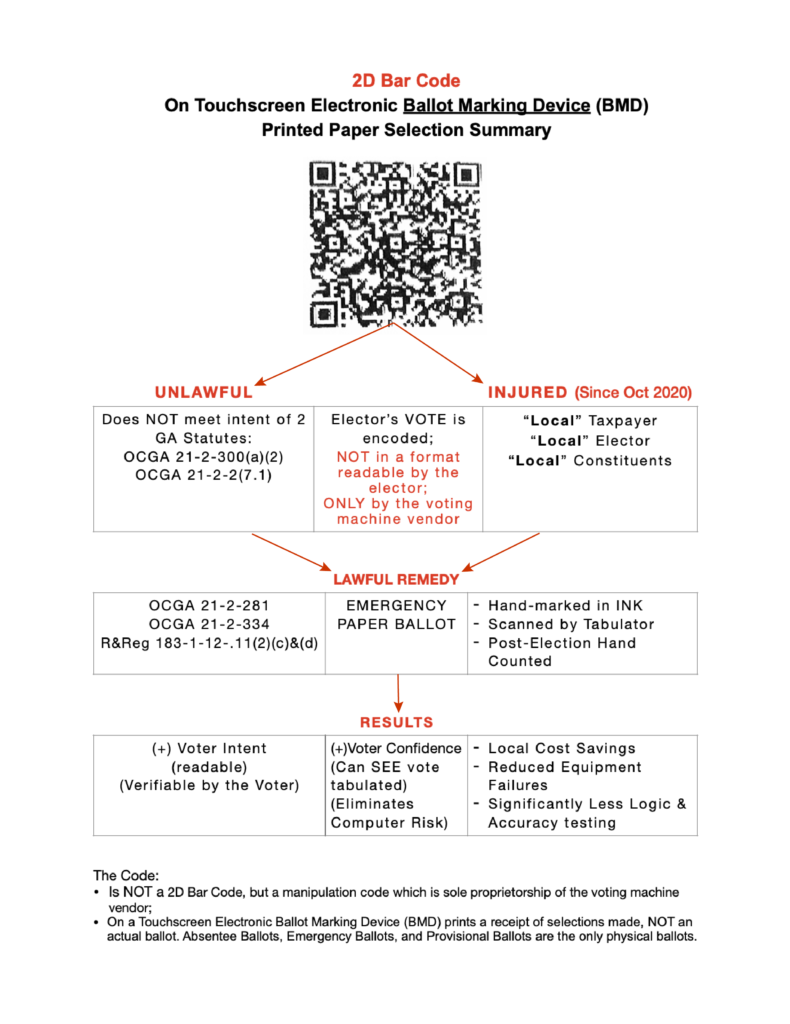
The DDP’s assurances ignore clear violations of Georgia law. State statute O.C.G.A. § 21-2-300(a)(2) requires that electronic ballot markers produce paper ballots “readable by the elector.” Yet, as established in Curling v. Raffensperger, Georgia’s Dominion voting system encodes votes in a QR code-a mark unreadable by voters-making it impossible for them to verify how their vote is actually recorded. This is not a theoretical concern; it is a direct violation of the law and has been recognized as such by a federal judge.

Security Concerns
Security lapses with the Dominion system are not speculative. The encryption codes are stored in plain text and system administrator password has been publicly available. The system relies on foreign corporations and microchips, raising national security concerns. These vulnerabilities are not just theoretical; they have been cited in ongoing litigation and legislative debate as reasons the system cannot be trusted to safeguard the vote. In fact, a ballot marking device was hacked in a US District Court with a ball point pen. Even the current Georgia Governor Brian Kemp has famously stated, “You give anybody a voting machine and they can hack it.”

“You give anybody a voting machine and they can hack it.” ~ Governor Brian Kemp

The Solution: Hand-Marked Paper Ballots
The solution is neither radical nor untested. Nearly seventy (70) percent of the United States votes on hand-marked paper ballots. Georgia law already allows for hand-marked paper ballots using the Absentee/Provisional/Emergency ballots, that can be scanned by tabulators, and, crucially, hand-counted and certified at the precinct level as required under O.C.G.A. § 21-2-437. Legislation advancing through the General Assembly would expand this option, providing voters the ability to mark their choices with pen or pencil, ensuring transparency and auditability. This approach is fully compliant with O.C.G.A. § 21-2-300(a)(2) and existing Georgia Rules & Regulations 183-1-12-.11, and would restore public trust by providing a verifiable paper trail. This process is transparent, auditable, and fully compliant with state law and federal civil rights protections. It would also comply with SB189 passed in 2024 requiring the removal of the QR code.

Conclusion
The DDP’s narrative is built on selective engagement and wishful thinking, much like the emperor’s courtiers admiring invisible clothes. Until they confront clear evidence of legal violations and security failures, their reassurances ring hollow. Georgia’s voters deserve elections that are not just secure in theory, but verifiable, transparent, and compliant with the law in practice. The path forward is clear: implement hand-marked paper ballots, publicly hand-counted and certified at the precinct, to ensure every voter can see-and trust-how their vote is counted.


Field Searcy is co-founder of GeorgiansForTruth.org, a grassroots volunteer effort to bring election integrity to Georgia.


By Field Searcy

The phrase “something is rotten in the state of Denmark” from Shakespeare’s Hamlet perfectly captures the troubling state of election integrity in Georgia, as revealed by the long-running Curling v. Raffensperger case. What began in 2018 as a challenge to Georgia’s outdated Diebold voting machines has evolved into a damning exposé of the state’s current Dominion voting system, raising serious concerns about transparency, security, and accountability. Yet, after years of litigation, federal Judge Amy Totenberg dismissed the case on March 31, 2025, citing “standing” as the reason—despite the glaring contradictions and troubling circumstances surrounding her decision. The case’s dismissal leaves Georgians with more questions than answers and a growing sense of distrust in the system meant to safeguard their democracy.

A Dismissal That Defies Logic
Judge Totenberg’s decision to dismiss the case on “standing” is as baffling as it is infuriating. “Standing” is typically a threshold issue determined at the beginning of a trial, not after 17 days of court testimony, a 14-month delay before issuing a final order, and 33 pages of detailed findings that highlight substantial concerns with Georgia’s voting technology. In her original 135 page order to conduct the trial in the first place, Totenberg declared the Dominion system to be in violation of Georgia law (O.C.G.A. 21-2-300), which requires a human-verifiable ballot. Yet, despite these findings, she dismissed the case on a technicality, effectively sidestepping her duty to provide justice to the people of Georgia. This decision is not just a legal failure—it is a betrayal of public trust.

Suspicious Timing and Public Comments
The timing of Totenberg’s order raises even more red flags. It was released during the final week of the Georgia General Assembly session, during which the Secretary of State Brad Raffensperger was requesting a $66 million budget to comply with SB189, a bill aimed at removing the controversial QR code from ballots. The timing seems far from coincidental. Adding to the suspicion, Totenberg made public comments after her decision, stating, “If these legislative measures are ultimately funded and implemented, they are the type of timely legislative action that can bolster public confidence in the management and security of Georgia’s voting system.” These remarks sound less like impartial judicial commentary and more like an endorsement of spending $66 million on a system upgrade for a contract that will be up for renewal in just 2-3 years. Why invest such a significant sum in a system that has already been declared noncompliant with state law and riddled with security vulnerabilities?

Alarming Trial Revelations The four-week bench trial, which concluded in February 2024, revealed shocking vulnerabilities in Georgia’s election system. Dr. Alex J. Halderman, a cybersecurity expert, demonstrated in court how votes could be flipped on a ballot-marking device (BMD) using nothing more than a ballpoint pen. This was not the first time such a demonstration had occurred; Halderman performed a similar hack three years earlier, yet Raffensperger failed to implement any of the four Election Assistance Commission (EAC)-approved software updates that could have addressed these vulnerabilities. Even more troubling, testimony from the Secretary of State’s office revealed that no one in the office is responsible for overseeing the cybersecurity of Georgia’s election system. Instead, this critical responsibility has been outsourced to Dominion itself—a glaring conflict of interest.

Judge Totenberg’s Abdication of Duty
Judge Totenberg’s handling of this case should be condemned by all who value justice and accountability. Her delays, which stretched the case over 14 months after the trial concluded, wasted time and resources for all involved. Her ultimate dismissal on “standing” after extensive testimony and findings of legal violations is a basic abdication of her duty to provide justice to the people of Georgia. The people deserved a ruling on the merits of the case, not a procedural cop-out that leaves the state’s election system in limbo.

The People Must Act
If this case has taught us anything, it is that we cannot rely on the courts to protect our elections. It is up to We the People to demand change. The Georgia General Assembly must act to restore confidence in our elections by passing HB397, which removes Georgia from the controversial ERIC voter registration system, and SB214, which replaces BMDs with hand-marked paper ballots. Additionally, counties must follow existing law (O.C.G.A. 21-2-437) to conduct full hand counts and certification at the precinct level. These measures are essential for transparency to ensuring that every vote is secure, verifiable, and counted accurately.

A Call to Action
The Curling v. Raffensperger case has exposed deep flaws in Georgia’s election system, but it has also highlighted the resilience and determination of those fighting for transparency and accountability. Now, it is up to the citizens of Georgia to take up the mantle. Contact your state senators and representatives and demand action. The integrity of our elections—and the future of our republic—depends on it.


Field Searcy is co-founder of GeorgiansForTruth.org, a grassroots volunteer effort to bring election integrity to Georgia.

What: VOTER ROLL VERACITY Press Conference
When: Monday, February 24, 2025, 2pm
Where:
 Georgia State Capitol, South Atrium Steps

Speakers include:
• Dr. Rick Richards – Founder of EagleAI
• Mike Nixon – State Director for United Sovereign Americans
• Dr. Jerome Corsi, PhD – Renown political scientist and best selling author

Opening remarks by Field Searcy, co-founder of Georgian’s For Truth:

Good afternoon, ladies and gentlemen, and thank you for joining us today for this critical press conference on VOTER ROLL VERACITY. My name is Field Searcy, I’m with Georgians For Truth.  We are here to address the core issues that undermine transparency, accuracy, and trust in Georgia’s elections. While the legislature has made a number of election law changes each year since the deployment of the current system, these efforts have only tinkered around the edges. They have failed to confront the fundamental problems that threaten the integrity of our electoral process.

These three problems are:

  • An insecure electronic voting system: Georgia’s current voting system was not designed with security at its foundation and does not meet the requirements of state law, NIST or VVSG federal standards. The security issues exposed indicate a glaring vulnerability and a national security risk that must be addressed.
  • Failure to enforce existing election laws: The Secretary of State, the Governor, and the Attorney General have failed to follow and enforce the existing laws already in place, further eroding public trust in our elections.
  • Inaccuracies and manipulation of voter registration rolls: The voter rolls, which are the foundation of the entire election system, have been plagued by bloated and dirty registrations, widespread irregularities, ineligible registrations, and alarming evidence of manipulation caused by an algorithm, creating cloned voter records.

Today, we will focus on the alarming number of issues with our voter registration rolls from three different angles. We are fortunate to have with us today three distinguished speakers who bring a wealth of expertise and insight into these issues.

First, we will hear from Dr. Rick Richards, co-founder of EagleAI, a voter roll database maintenance application. Dr. Richards is a family physician with 40 years of experience in large-scale population data management. He and his team have spent four years reviewing voter registrations from 38 states plus DC, and he will share his findings on the failures of ERIC and the urgent need for reform in Georgia’s voter registration system.

Next, we will welcome Mr. Mike Nixon, an IT professional and a State Director for United Sovereign Americans. Mr. Nixon will present data on Georgia and other states, highlighting the alarming evidence of voter roll registration irregularities in both the 2020 and 2024 elections.

Finally, we will hear from Dr. Jerome Corsi, a renowned political science professor and author of over 30 books, including two #1 New York Times bestsellers. Dr. Corsi will discuss groundbreaking research on voter roll algorithms behind “duplicated modified records”, and the broader implications for election integrity.

This is not just about identifying problems—it’s about having our representatives acknowledge the issues and take corrective steps in finding solutions. We must move beyond surface-level changes and take bold, decisive action to ensure that Georgia’s elections are secure, transparent, and trustworthy.

Thank you for being here today. Let’s begin by welcoming our first speaker, Dr. Rick Richards.